© 2026 Wordle Hints. Not affiliated with The New York Times Company.
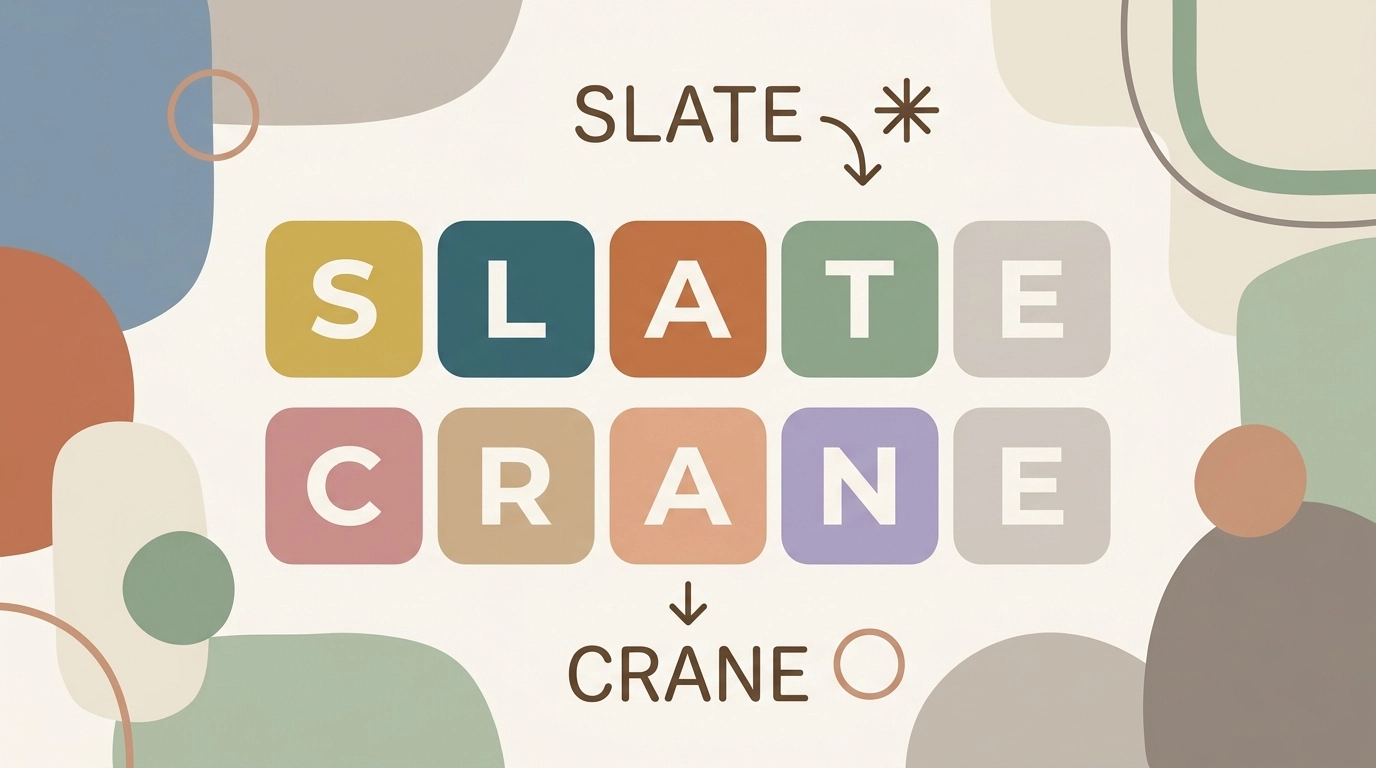
Why SLATE is a Better Starting Word Than CRANE
Stuck?
Picking a starting word feels small. But it shapes the whole board.
CRANE has history.
SLATE has the edge.
Not by magic.
By coverage.
By positioning.
By cleaner follow-up guesses.
If your goal is simple — learn more on turn one and protect your streak — SLATE usually gives you more useful information than CRANE. That does not mean CRANE is bad. Far from it. It is still one of the best openers in Wordle. But if you are choosing between the two, SLATE is the slightly sharper tool.
Checking. Comparing. Explaining.
Let’s break it down.
The Math of First Guesses
A good first guess does two jobs at once.
First, it tests common letters.
Second, it tests them in strong positions.
That matters because Wordle is not only about whether a letter appears. It is also about where that letter tends to land. A guess that checks high-value letters in high-value slots gives you better odds of early greens and more decisive yellows.
SLATE does that very well.
It packs five common letters into one word: S, L, A, T, E. No repeats. No wasted space. And each letter appears in a spot that often makes sense in actual answers. That means the feedback from SLATE is often easier to act on than the feedback from CRANE.
S vs C
Start with the first tile.
S is a workhorse in Wordle. It appears often, and it is especially useful early because it quickly confirms or rules out a huge cluster of words.
C is still strong. But it is less flexible. Many common answer patterns simply do more with S than with C. So when SLATE opens with S, it tends to hit more often and cut the pool faster.
That first letter matters more than it looks. One green or yellow on tile one can split the answer list fast. One gray can be just as useful if it removes a very common branch.
L vs R
Now the second tile.
This is where the debate gets closer.
is excellent.
But in SLATE, L works beautifully with the rest of the word. It pairs naturally with A and E, and it checks a lot of patterns that show up in actual answer lists. In other words, SLATE is not just a set of good letters. It is a good arrangement of good letters.
That last part is easy to miss. Wordle rewards structure.
Why CRANE Falls Behind
CRANE became popular for a reason. It covers common letters. It feels balanced. It has a nice spread of consonants and vowels. For a long time, many players treated it like the default smart opener.
And honestly?
That was fair.
But the difference between two great starters comes down to tiny gains. A little more information. A little more positional value. A little less ambiguity after guess one.
That is where SLATE wins.
CRANE gives you C, R, A, N, E. Strong set. But C is usually less valuable than S in the opening slot, and N does not always pull as much weight as T for narrowing common endings and patterns. So while CRANE still performs well, its average first-turn feedback is often just a bit less helpful.
Tiny gap.
Real gap.
And in Wordle, tiny gaps matter.
Positional Power
This is the strongest case for SLATE.
Letter frequency alone is not enough. You want letters where they are most likely to matter. SLATE checks that box nicely:
That is a very practical layout. It does not just find letters. It creates patterns.
at the end? Great.
Get a yellow
? Also great.
Miss on
CRANE has some positional value too, especially with A and E. But its overall pattern is a little less efficient. The result: more second guesses where you still have several similar answers left.
Best Wordle Starting Words
So is SLATE the best starting word, period?
Maybe. Maybe not. The top tier is crowded. Words like SLATE, STARE, CRANE, TRACE, and SALET all get attention because they test useful letters with no repeats. The exact winner depends on the answer list, the scoring method, and whether you care more about average solve count or worst-case survival.
But if you want a starter that is easy to remember, easy to use every day, and statistically strong in normal play, SLATE is a fantastic choice.
It does three things well:
That combo is why so many strategy-minded players stick with it.
Wordle Tips and Tricks
Want more value from your opener?
Do this:
Example?
Say SLATE gives you a yellow A and green E. Nice. Now you are not guessing randomly. You are filtering. Looking for words that fit the lane without burning letters you already know.
That is how better starters help. They do not solve the puzzle for you. They make turn two cleaner.
If you want that process faster, use the Wordle Vibe tool. Enter your guess. Match the colors. See how many valid words remain. Then choose whether to stay in Analysis Mode or view full suggestions in Solution Mode.
Helpful.
Not spoiler-heavy.
Hard Mode Tactics
Hard mode changes the feel of opening words.
Because you must reuse revealed hints, some strong starters can walk you into a trap. SLATE is not immune to that. If you reveal three good letters early, you may face a cluster like -ATE or S-A-E with too many live options.
Oops!
That does not make SLATE weak. It just means your second guess matters. In hard mode, your job is to reduce branches without wasting the forced information you already have.
So if SLATE points toward a crowded pattern, slow down. Count candidates. Look for the letter that splits the group best. Sometimes the “best” next guess is not the most likely answer. It is the one that eliminates the most possibilities.
That is exactly where Wordle Vibe helps. We rank suggestions by letter frequency among the remaining answers, so you can choose the guess that cuts deepest instead of guessing blind.
Why Consistency Wins
One more thing.
The best starting word is not only about raw math. It is also about habit.
Using the same opener every day gives you:
So yes, you can bounce between trendy openers. But if you want steadier results, pick one elite word and learn it deeply.
SLATE is perfect for that.
Reliable.
Balanced.
Easy to build around.
Summary: SLATE vs CRANE
CRANE is still great.
SLATE is just better.
Not by a mile.
By enough.
If you want the short version, here it is:
That is the whole argument.
Pick SLATE.
Use it consistently.
Read the board carefully.
Protect the streak.
Thanks!